ICS 6B Sections 1.12, 1.13, and all of 2
ICS 6B Reading Notes
- 1.12: Rules of inference with propositions
- 1.13: Rules of inference with quantifiers
- 2.1: Mathematical definitions
- 2.2: Introduction to proofs
- 2.3: Best practices and common errors in proofs
- 2.4: Writing direct proofs
- 2.5: Proof by contrapositive
- 2.6: Proof by contradiction
- 2.7: Proof by cases
1.12: Rules of inference with propositions
- There are rules of inference that can be generally applied to arguments to know if they are valid
- List of rules:
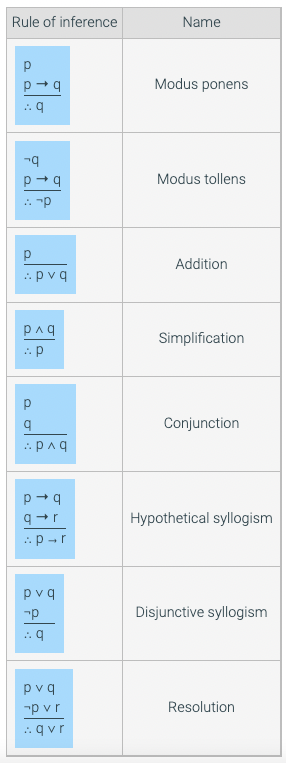
- List of rules:
- Proving the validity of an argument using the rules of inference and laws of propositions is called a logical proof
- Each step has different justifications; providing a hypothesis is calleda “hypothesis”, and you must state the law/rule if not
- Example of a logical proof:
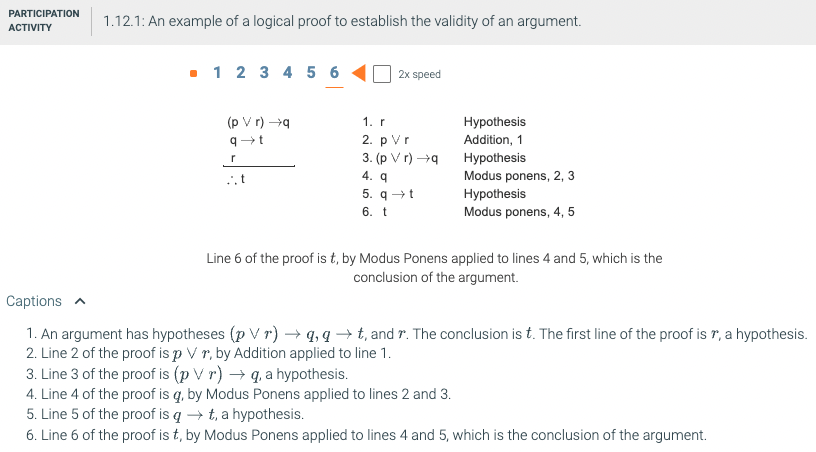
STUDY THIS SECTION, Challenge Activity 1.12.1 part 4 is good
1.13: Rules of inference with quantifiers
- To apply a rule of inference to a quantified statement, you must use an element in the domain of the statement
- Elements can be defined in the hypotheses, example below:
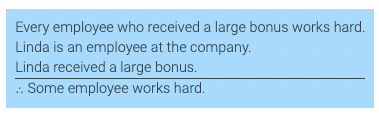
- Can use one of two elements in a logical proof
- Arbitrary elements have no special properties other than the fact that they are in the domain
- Particular elements can have properties that aren’t shared by others in the domain
- An element defined in a hypothesis is particular by default and must be labeled as “Hypothesis”, while an element defined in the proof is labeled “Element definition”
- Elements can be defined in the hypotheses, example below:
-
Table of rules of inference for quantified statements:
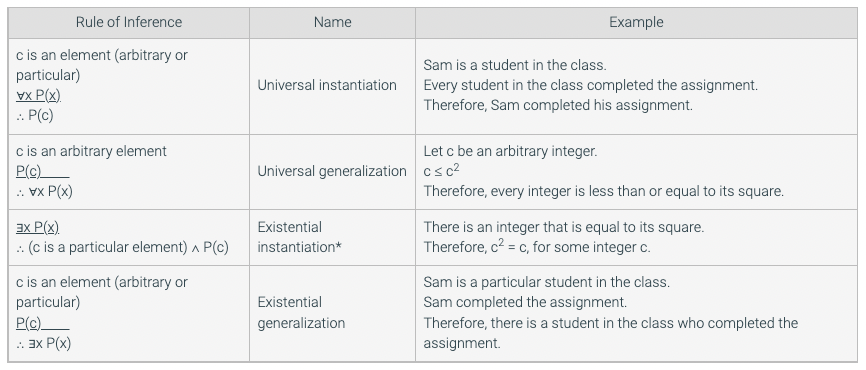
- A common error is defining the same variable for two different instances of existential instantiation; make sure to mark one variable as C and one as D
STUDY THIS SECTION, Challenge Activity is good
2.1: Mathematical definitions
- Even integers can be written as 2k; odd ones are written as 2k + 1 (also known as parity)
- Same parity is if two numbers are both odd or even; if not, they are of opposite parity
- Rational numbers are ones where there exists integers x, where y!= 0 and r = x/y
- A number (x) that divides another number (y) is one where y % x == 0
- Denoted as x|y (x divides y); x is a multiple of y if it divides it
- Numbers that don’t divide are denoted as so:

- A number that divides another is called a multiple
- Prime numbers and composite numbers (if you don’t know this shit ur dumb)
- Inequalities: <, >, =, etc.
2.2: Introduction to proofs
-
Theorem: A statement that can be proven to be true via a proof
- Proofs might use axioms which are statements assumed to be true
- Theorems are often rewritten as universally or existentially quantified statements
- Proof of exhaustion: A proof that is done by examining every element in a domain
- Proofs involving universal generalizations uses a statement to define an arbitrary element
- Counterexample: definition of one element in a domain that makes the statement false
-
Existence proofs show that existential statements are true
- Constructive proofs of existence are the most common, and they provide a specific example in the domain that satisfies the statement
- Nonconstructive proofs of existence provide an example with certain properties that satisfies the statement
- Disproving existential statements requies DeMorgan’s Law and a proof that a negated statement is true
- Example:
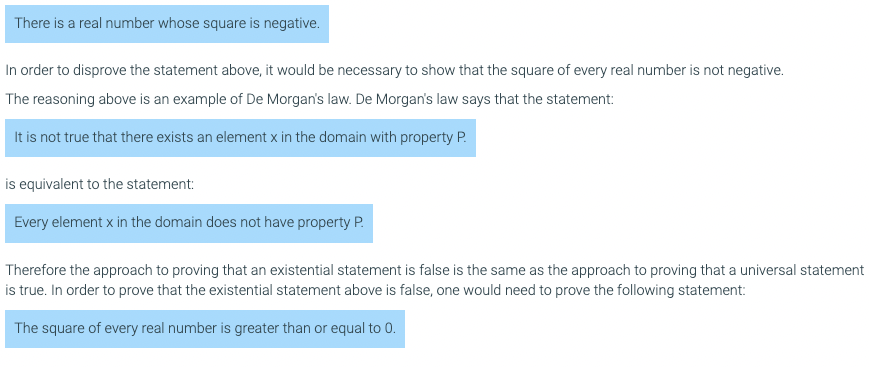
- Example:
2.3: Best practices and common errors in proofs
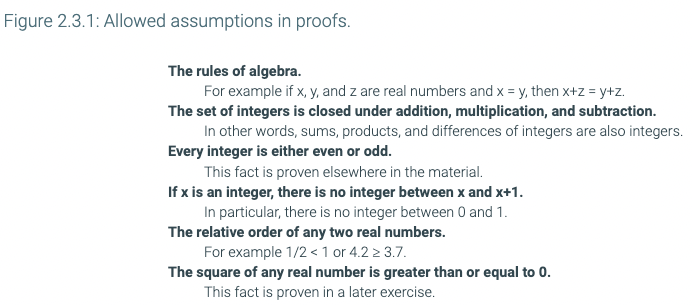
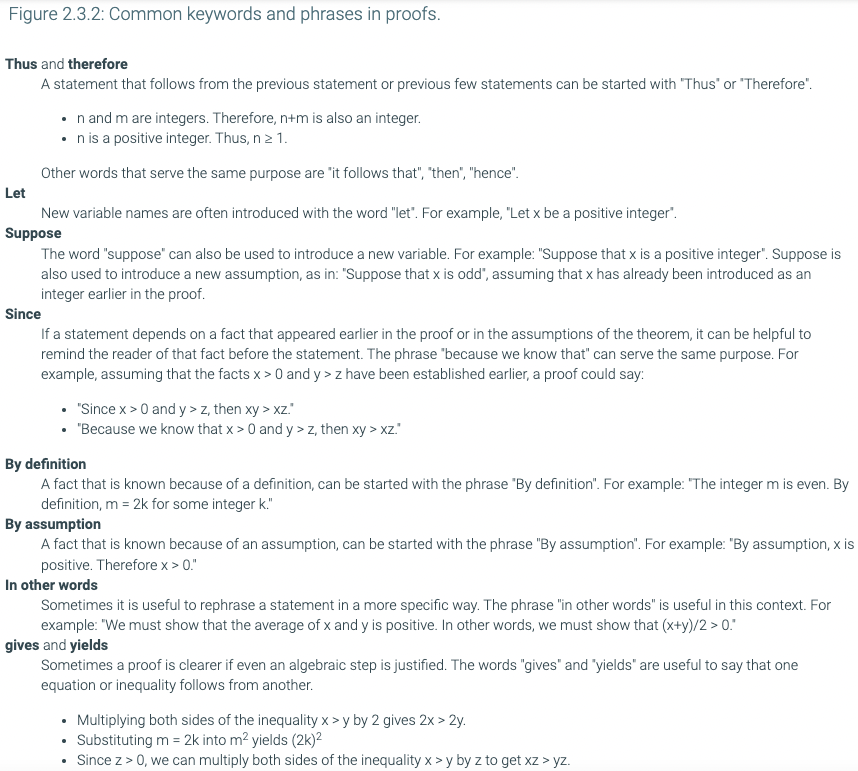
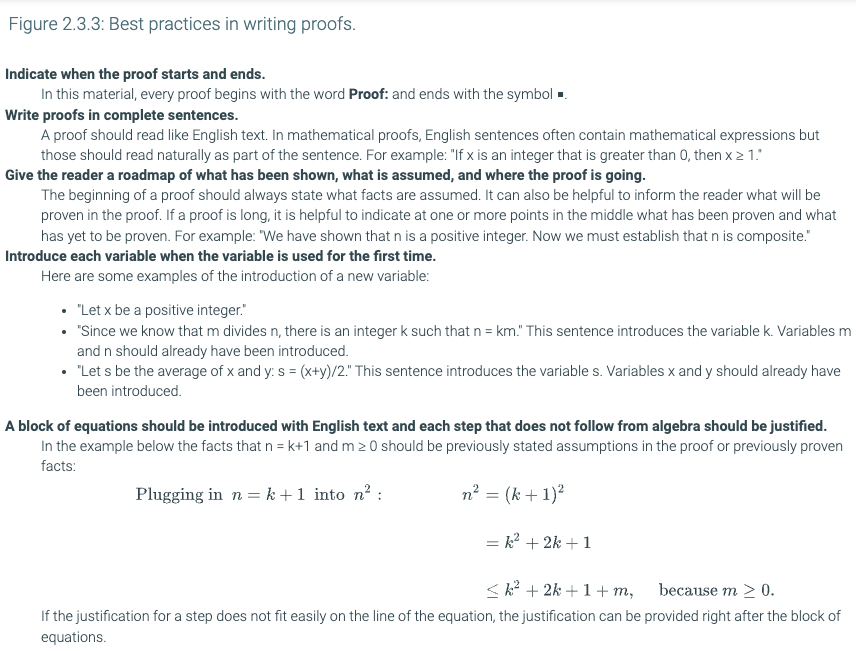
Section includes various important factoids to know
2.4: Writing direct proofs
- Direct proofs: A hypothesis, p, is assumed to be true and the conclusion, c, is proven due to that assumption (p -> c)
2.5: Proof by contrapositive
-
Proof by contrapositive: A proof of a conditional theorem of the form (p -> c) by proving (!c -> !p)
- Example of what to do with multiple hypotheses:
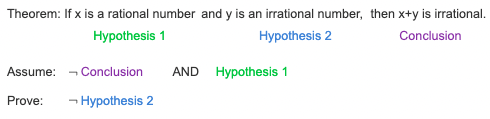
- Example of what to do with multiple hypotheses:
2.6: Proof by contradiction
-
Proof by contradiction assumes that the theorem is false and shows a logical inconsistency with such assumption; also called an indirect proof
- Example:
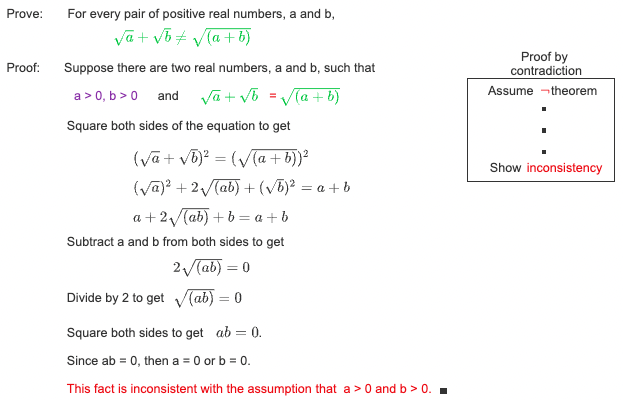
- Example:
2.7: Proof by cases
-
Proof by cases: Separates the domain into separate classes (cases) and proves that each class is true
- Example:
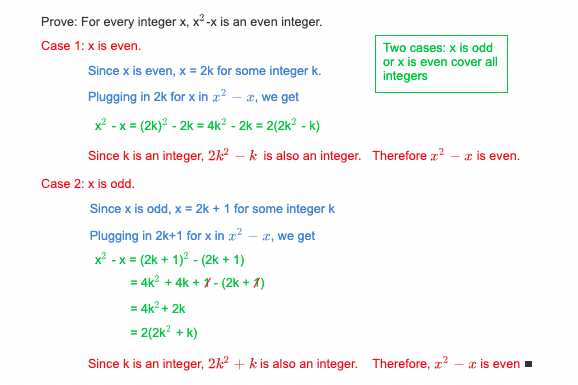
- Example:
-
Without loss of generality is written to show that one case can apply to all cases
- Example:

- Example: